
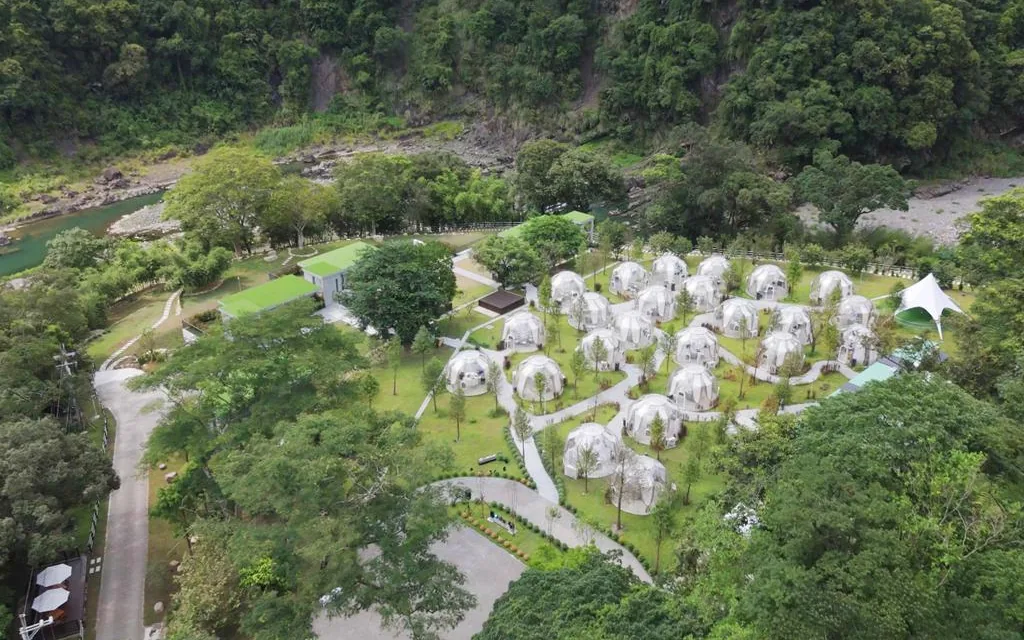
Glamping & resorts
Plan the guest experience and the operating reality.
Glamping pods and dome tents for resorts, campsites and rural hotels. Start with occupancy, privacy and the opening date — not a shell diameter.
Define what guests are booking.
Separate couples’ rooms, family stays and premium suites. Confirm sleeping, bathroom and luggage zones before choosing a model.
Move from an idea to a visible configuration.
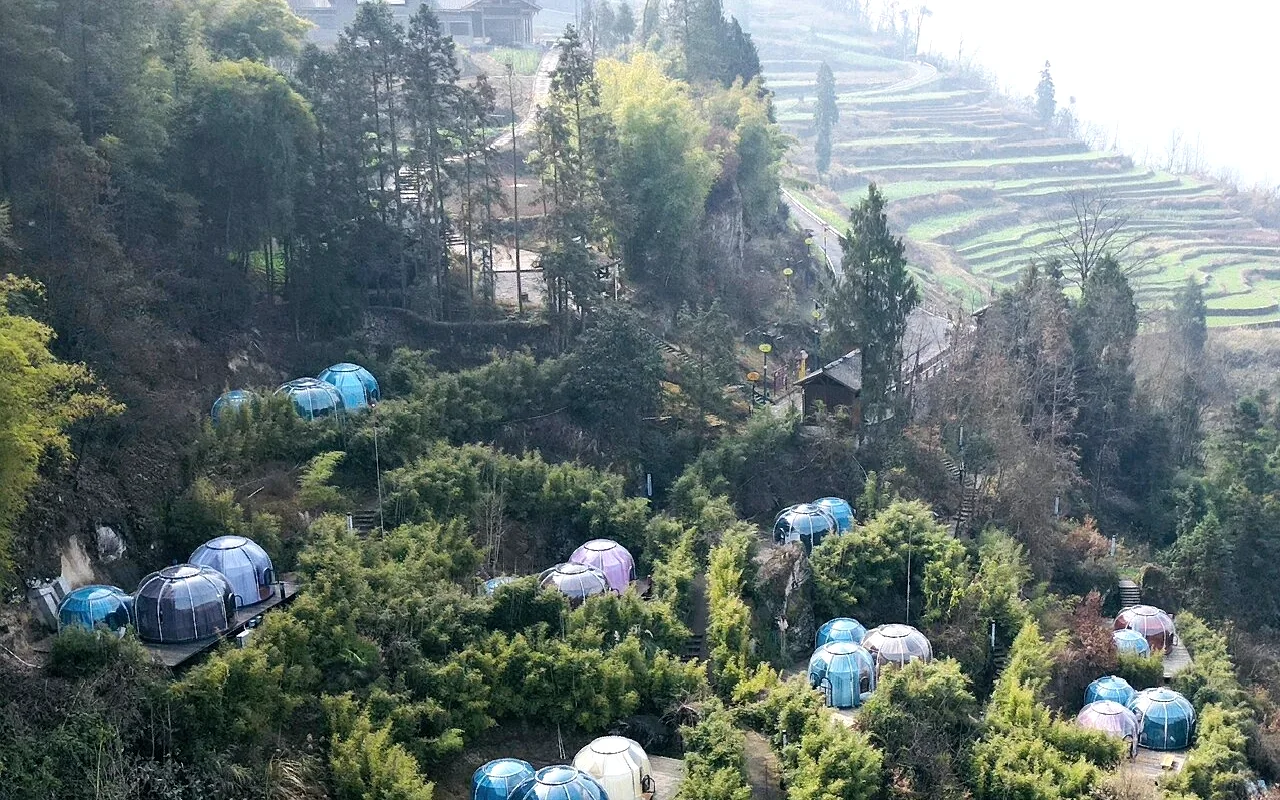
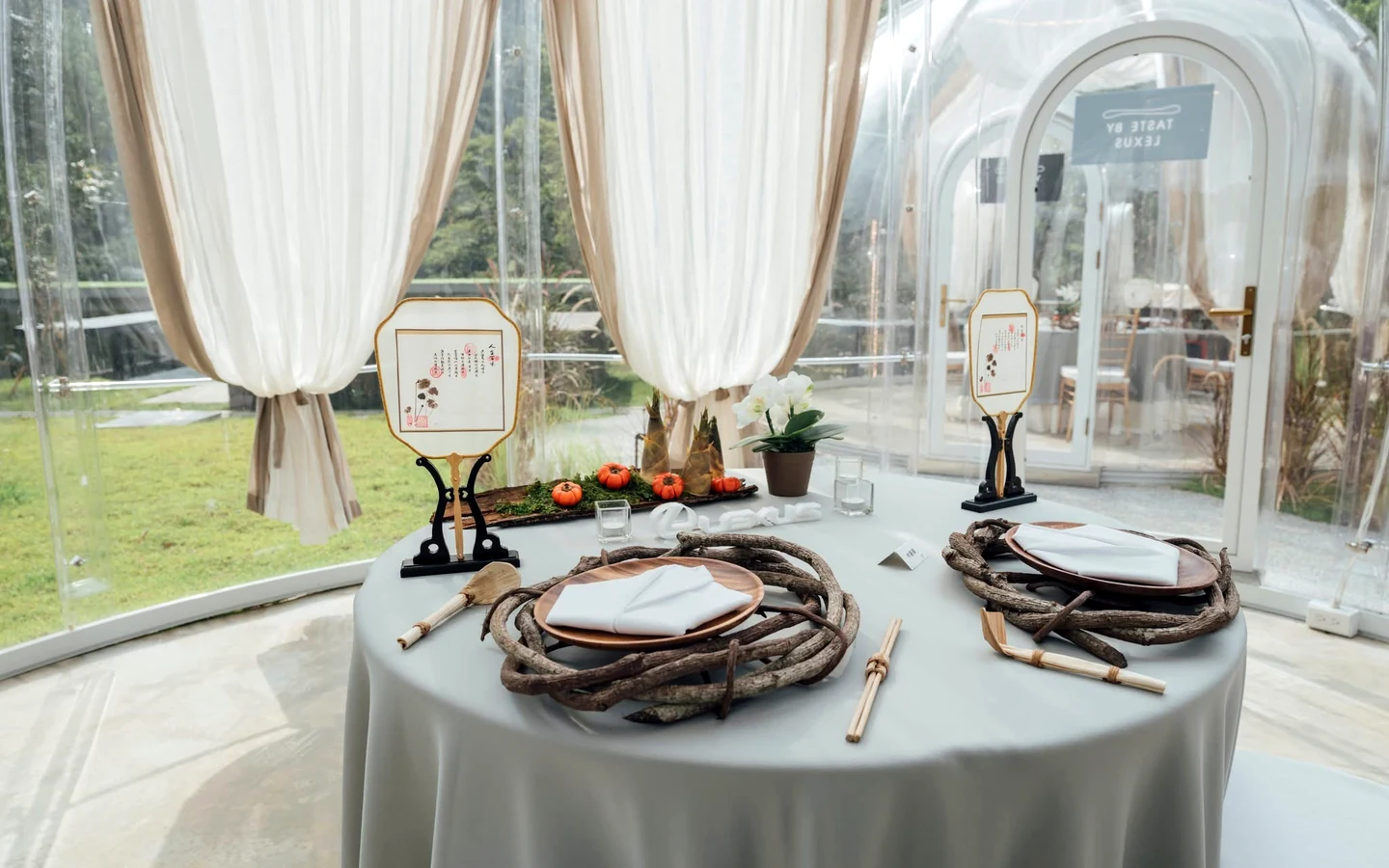
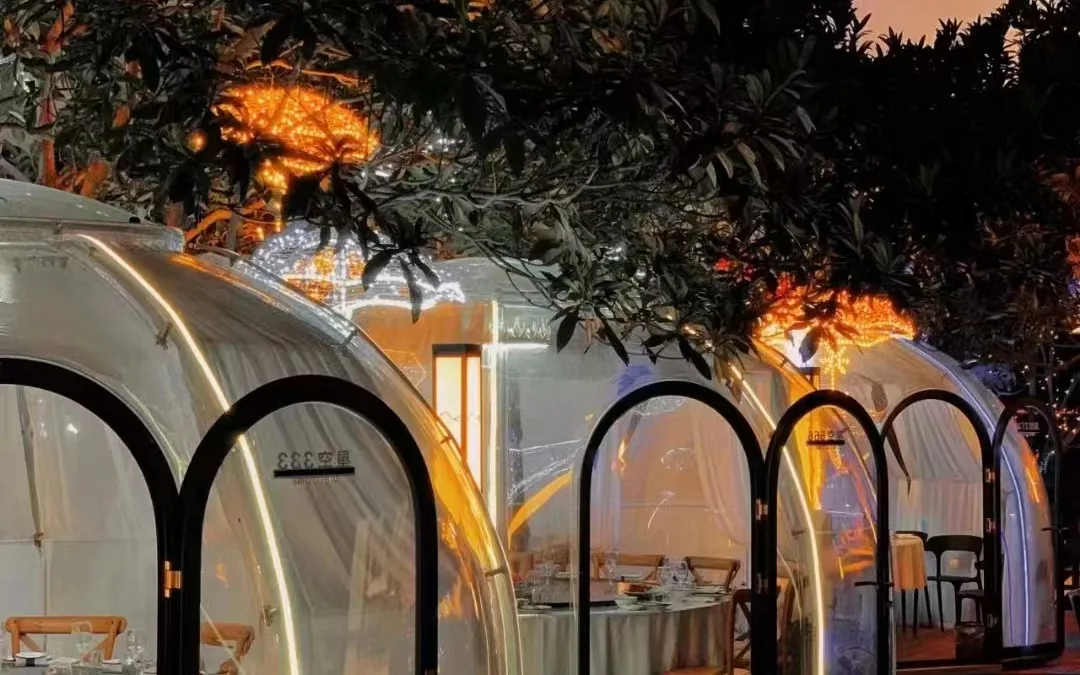
Match the room plan to the stay.
- Round formats for compact couples’ rooms
- Larger round formats for bed, lounge and circulation
- Oval or extended formats for separated bathroom and living zones
A glamping pod is a room, so price it like one.
A 5.0 m dome gives 19.6 m² and starts at US$2,167 EX-WORKS. Replace every figure below with your own rates — the point is the shape of the calculation.
| Your input | Worked example |
|---|---|
| Nightly rate | US$180 |
| Occupancy | 55% |
| Nights per year | 300 |
| Revenue per pod per year | US$29,700 |
| Shell cost as a share of first-year revenue | About 7% |
Illustrative arithmetic, not a forecast, and it excludes freight, foundation, deck, interior, utilities and local approvals. Those belong in the same calculation — send us the unit count and the destination port and we will put a landed figure against it.
What decides the opening date.
- Groundworks, not the domes. Platforms, drainage and services are almost always the critical path.
- One container, one phase. Ask us how many of your chosen model fit a container before you fix the phase count — it usually changes it.
- Order the same accessory package across the phase. A resort with three ventilation specifications is a resort with three spares lists.
- Housekeeping decides the shell. Cleaning access, curtain type and floor finish are chosen by the people who turn the room over, not by the person signing the order.
- Snow, salt air and prevailing wind change the anchoring detail. Document them before quotation, not after delivery.
Resolve the inside before the outside.
- Bed orientation and view line
- Bathroom privacy and service access
- Door swing, luggage and housekeeping route
- Deck, foundation and utility entries
Use climate and operating hours to choose the system.
Air conditioning is not required in many climates. Start with airflow, shade and occupancy. If active cooling remains necessary, larger domes can accommodate a client-supplied floor-standing unit subject to layout and electrical planning.
Plan the rollout, not only the room.
- Confirm site loads, permits and foundations locally
- Coordinate utilities, interiors and bathroom works outside the shell scope
- Reserve time for production, freight, customs and installation
- For multiple units, agree phasing, spares and the opening sequence
Review comparable configurations honestly.
Until a project has verified location, model, quantity and outcome records, it is shown as a reference installation—not a fabricated case study.
A glamping pod that still works in the shoulder season.
A Celenest glamping pod is a rigid polycarbonate shell, not a canvas glamping tent: about 91% light transmission, rated level 14 for wind and usable from −40 °C, with a 10-year warranty. It needs no blower, no re-proofing and no seasonal take-down — which is what turns a summer camping pod into a room you can still sell in November.
- Resorts and rural hotels. A dome hotel room is priced as accommodation, not as a tent; the shell is a small share of first-year room revenue.
- Campsites. Glamping pods let you charge a room rate on a pitch that used to earn a pitch fee.
- Bubble hotel concepts. Guests photograph the ceiling, not the lobby. The shell is the product.
- Multi-unit sites. Agree phasing, spares and a single accessory specification across the whole resort dome cluster.
Who you are buying from matters on a multi-unit order: Celenest is the dome division of Suzhou Bakway (IATF 16949 and ISO 9001), and the ordering sequence is on how to order.
Glamping pods for sale, priced from the factory.
Every model is available as a glamping pod for sale in single units or in batches for a whole site. Eleven sizes run 2.1 m to 9.7 m, from US$1,094 EX-WORKS. Two units or more move to distributor pricing.
We are not going to guess what you can charge per night. Local rates, labour and permits differ too much for that number to mean anything coming from us. What we can put in writing is what the shell costs and what it does.
| What operators compare | A Celenest glamping dome tent |
|---|---|
| Shell cost, Ø4.5 m class | US$1,960 EX-WORKS. Comparable rigid domes list at four to five times this, before accessories. |
| Operating window | Rated level 14 for wind and −40 °C to 120 °C. It does not close for winter. |
| Warranty | 10 years, covering under 6% light-transmission loss and a yellowing index under 10 (ASTM D1925). |
| Running parts | None. No blower, no fan, no annual film replacement. |
| Exit | Bolt-together. It comes apart, moves and resells. |
Across the UK, operators take 65–80% of annual revenue in four to five months. A shell that stays usable through winter is worth more than a shell that is cheaper to buy. Ours happens to be both.
What site owners ask before ordering.
Can I buy glamping pods in single units, or is there a minimum order?
Single units are sold. Two units or more move to distributor pricing. Eleven models are available as glamping pods for sale, 2.1 m to 9.7 m, from US$1,094 EX-WORKS.
Are these glamping dome tents usable through winter?
Yes. The shell is rated level 14 for wind and holds its properties from -40 °C to 120 °C. There is no blower to fail and no fabric to freeze. Winter is the season the transparent roof earns its rate.
How does a rigid dome compare with an inflatable bubble on a commercial site?
An inflatable needs a blower running continuously and a film replaced periodically. A power cut empties the room. A rigid polycarbonate shell has no running parts and carries a 10-year warranty.
What is not included in the EX-WORKS price?
Freight, duty, groundworks, decking, furnishing, power and water. The price covers the shell kit with export packing. We will say plainly which items sit outside it before you order.
How long does a site of several units take to put up?
Each shell arrives as a labelled bolt-together kit with eight assembly steps. Two people handle the small models; larger diameters need a third pair of hands for the crown panels. No contractor is required.