
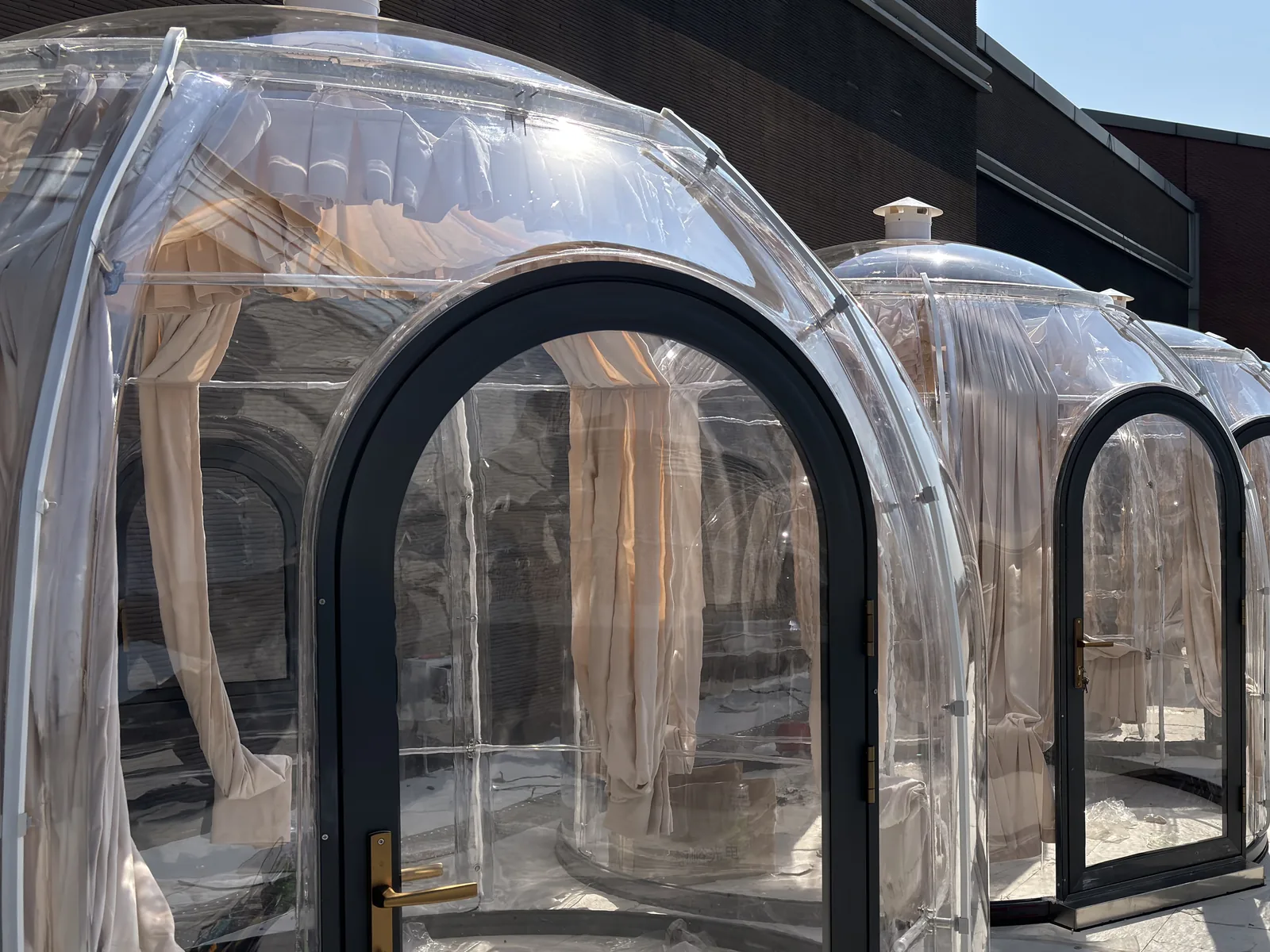
Clear tent vs bubble tent
Same photograph. Three different products.
Clear tent, bubble tent, bubble house, igloo dome — the names are interchangeable, the construction is not. What you are actually choosing is the material.
The three things sold as a clear tent.
An inflatable bubble tent is PVC or TPU film held up by air pressure, with a blower that must run continuously; it is light, cheap and typically finished outdoors in about three years.
A film-on-frame clear tent stretches thin PC or PVC film over a metal frame — no blower, but the skin is still the weak point. A solid polycarbonate dome like a Celenest is a rigid moulded shell bolted to an aluminium base ring: no air pressure, no fabric, about 91% light transmission, impact resistance around 200 times that of glass, service range −40 °C to 120 °C, B1 fire rating, level 14 wind rating and a 10-year warranty.
What changes when the material changes.
| Inflatable bubble tent | Film on frame | Solid polycarbonate (Celenest) | |
|---|---|---|---|
| Holds its shape by | Air pressure | Tension over a frame | The shell itself |
| Power to stay up | Blower runs continuously | None | None |
| If the power fails | It comes down | Unaffected | Unaffected |
| Puncture | Ends the night | Tears spread | Not applicable — rigid sheet |
| Outdoor service life | About 3 years | Varies with the skin | 15 years or more with normal maintenance |
| Noise inside | Constant blower | Quiet; skin moves in wind | Quiet; 5–9 dB better than glass of the same thickness |
| Wind | Pressure dependent | Frame dependent | Rated level 14; anchoring specified per site |
| Winter use | Marginal | Marginal | Rated to −40 °C |
| Looks like | A temporary structure | A temporary structure | A building |
| Where the money goes | Lowest upfront, repeat purchase | Middle | Higher upfront, an asset that stays on the balance sheet |
Service-life figures for inflatable and film products are general industry experience for outdoor use, not measurements of a specific competitor. Polycarbonate figures are Celenest specifications: 91% light transmission per ASTM D1003, and a 10-year warranty covering under 6% light-transmission loss and a yellowing index under 10 per ASTM D1925.
When an inflatable is the right answer.
If you need something for a weekend brand activation, a photo set, an indoor event or a single wedding, an inflatable bubble tent is the sensible purchase. It is cheap, it packs into a car, and nobody cares what it looks like in year four. Buy the cheap one and enjoy it.
The calculation changes the moment the structure has to earn money on a Tuesday in February, sit in a garden all year, or be the thing a guest photographs and posts. Then you are buying years of service, not a night.
Five questions that separate the three.
- Is there a blower? If yes, budget for power, noise and the night it fails.
- What is the shell thickness and material? “PC” on a listing can mean film. Ask for the sheet thickness in millimetres.
- What is the warranty and what does it actually cover? Ask for the light-transmission and yellowing criteria, not just a number of years.
- What wind and temperature rating is documented? Ratings should come with a standard, not an adjective.
- What does year four look like? Ask the seller what the product looks like after three winters. The answer tells you which of the three you are buying.
Straight answers.
Is a bubble tent the same as a bubble house?
In search terms, yes — people use bubble tent, bubble house, clear tent, igloo dome and garden pod for all three constructions. In purchasing terms, no. Always ask what the shell is made of and how thick it is.
Does a rigid dome need a foundation?
It needs a flat, level, load-appropriate base — an existing patio, a timber deck or a slab. An inflatable needs level ground too, plus a power supply within reach of the blower.
Which one handles snow?
A solid polycarbonate shell sheds snow and is rated to −40 °C; loads for your site still need local engineering confirmation. Inflatables and film products are generally not the right choice where snow settles.
Is the rigid one much more expensive?
Higher upfront: a Celenest starts at US$1,094 EX-WORKS for the 2.1 m and runs to US$4,745 for the extended oval. The comparison that matters is upfront cost against years of service and whether it can be depreciated as an asset.
Can I see the difference in a photograph?
Rarely, which is exactly the problem. Look for a blower hose, seams and a soft outline in listing photos. A rigid shell shows hard panel joints and a crisp reflection, as in the image at the top of this page.
Clear bubble tent, clear dome tent, see through tent.
Listings mix a clear bubble tent, a clear dome tent, a bubble dome and a see through tent as if they were one category. They are not. Most of them are film held up by air pressure or tension. A Celenest is a solid polycarbonate shell: about 91% light transmission, rated level 14 for wind and B1 for fire, 15 years or more of outdoor service with normal maintenance. Read the shell specification, not the product name.
Is an outdoor bubble tent usable in winter?
An inflatable bubble tent stays up because a blower pushes air into it. In winter that is three problems at once: the fan runs continuously, condensation collects on a single film layer, and a power cut deflates the room with guests inside it.
A clear bubble tent made from solid sheet has none of those. There is nothing to inflate. A Celenest shell holds its properties from −40 °C to 120 °C and is rated level 14 for wind. So snow load and gales are a structural question rather than a seasonal shutdown.
| In winter | Inflatable bubble tent | Rigid clear dome |
|---|---|---|
| Stays up during a power cut | No | Yes |
| Running cost | Blower runs 24/7 | None |
| Rated temperature range | Film-dependent | −40 to 120 °C |
| Wind rating | Usually unstated | Level 14 |
| Replacement cycle | Film replaced periodically | 10-year warranty |
If you need something for two summer weekends a year, an inflatable is the cheaper answer and we will say so. If the room has to earn its place through a winter, buy the shell.
Bubble tent questions, answered without spin.
Are bubble tents for sale online the same as a polycarbonate dome?
No. Most bubble tents for sale are inflatable PVC film held up by a continuously running blower. A polycarbonate dome is a solid shell that supports itself. Both look similar in a photograph and behave completely differently in weather.
Can you buy a bubble tent that does not need a blower?
Yes — that is what a rigid clear dome is. Celenest shells are solid Bayer polycarbonate on an aluminium base ring, from US$1,094 EX-WORKS, with no fan, no pump and no film to replace.
Which lasts longer, an inflatable bubble tent or a rigid dome?
Inflatable films are consumables and get replaced. A rigid polycarbonate shell carries a 10-year warranty covering under 6% light-transmission loss and a yellowing index under 10 (ASTM D1925).
If it has to last, price the rigid one.
Eleven models from 2.1 m to 9.7 m, from US$1,094 EX-WORKS. Send the use, the site and your nearest port and we will come back with a configuration and a landed estimate.